

A Curious Event with a Scientific Basis
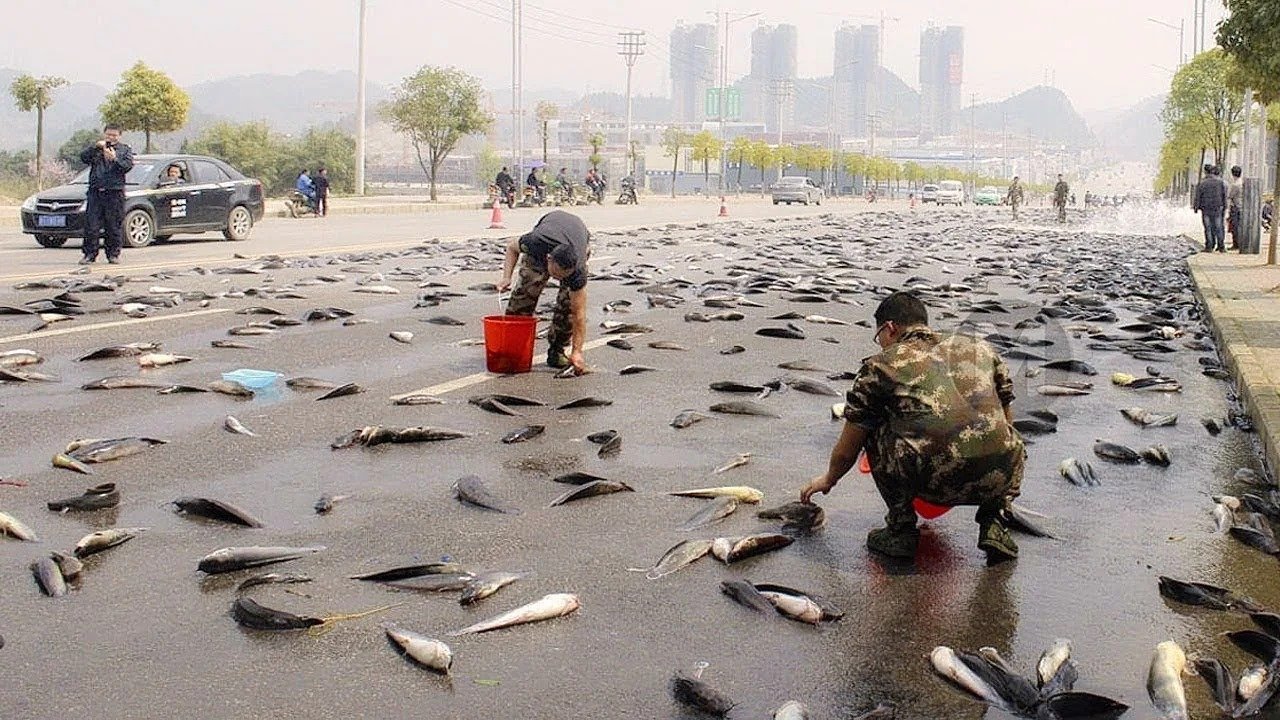
In several regions of Brazil, residents occasionally witness an unusual spectacle: fish scattered across roads and rooftops after a storm. Although the scene often prompts speculation and viral videos, researchers emphasise that the phenomenon has well-established meteorological explanations. It does not occur frequently, yet when atmospheric conditions align, aquatic animals can indeed be transported over considerable distances.
How Aquatic Animals Are Lifted into the Air
The event known as “fish rain” occurs when intense rotating wind systems form above lakes, reservoirs or rivers. These structures — commonly described as waterspouts or exceptionally strong whirlwinds — have the capacity to pull water upwards, along with small animals living near the surface.
Once drawn into the vortex, the organisms are carried horizontally by the storm’s winds. When the system weakens, the water and fish are released, descending over land. Although it appears as if the animals are falling from the sky, the source is the local waterbody from which they were initially lifted.
Why Certain Brazilian Regions Report More Cases
Brazil’s North and Northeast regions are among the areas where such occurrences have been most frequently documented. Meteorologists note that these regions often combine high temperatures with elevated humidity — conditions that favour the development of powerful convective storms.
In many towns, rivers and reservoirs are located very close to residential zones. This proximity increases the likelihood that residents will notice the phenomenon when a storm transports aquatic life onto streets and buildings.
Separating Folklore from Atmospheric Science
Historical accounts have occasionally attributed these episodes to supernatural or symbolic causes. However, experts underline that all verified events result from atmospheric dynamics rather than spontaneous animal falls.
Documented cases consistently show that the species found on the ground match those inhabiting nearby water bodies. In several incidents, the fish were alive or recently displaced, reinforcing that they were drawn directly from local aquatic environments.
Guidance for the Public When the Event Occurs
In Brazil, civil defence authorities advise residents not to handle the animals with bare hands after such events. The water drawn up by a vortex may contain sediment or contaminants that can pose health risks.
Authorities also encourage the documentation of these occurrences. Photographs, videos and time-stamped reports help meteorologists study storm behaviour and refine understanding of how these extreme wind systems form.
Conclusion
While rare, the “fish rain” phenomenon observed in Brazil is a legitimate result of powerful atmospheric activity. Far from being a mystery, it highlights how complex storm systems interact with the environment — and how extraordinary natural processes can appear when wind, water and weather converge in the same moment.