

Medical specialists in Singapore are observing an increasing number of glaucoma diagnoses among adults in their forties and fifties, raising concerns about the long-term impact of untreated myopia, or short-sightedness. According to eye health experts in the country, earlier generations who grew up with limited treatment options for myopia may now be experiencing complications associated with the condition.
Glaucoma is a group of eye disorders characterised by damage to the optic nerve, often linked to increased pressure within the eye due to the accumulation of fluid. The condition is one of the leading causes of irreversible blindness worldwide. While glaucoma is traditionally associated with individuals aged 60 and above, recent clinical observations in Singapore indicate that cases are being identified at younger ages.
Data from the Singapore National Eye Centre (SNEC), the country’s main public-sector institution for specialised eye care, show a noticeable increase in surgical procedures related to glaucoma among middle-aged adults. The number of glaucoma surgeries performed on patients aged 40 to 49 rose significantly over the past decade, while procedures among those aged 50 to 59 also increased considerably during the same period.
Researchers suggest that long-standing untreated myopia may play a role in this trend. Myopia occurs when the eyeball becomes elongated, causing light entering the eye to focus incorrectly on the retina. Over time, this structural change may weaken tissues within the eye, including the retina and optic nerve, potentially increasing the risk of several eye diseases.
Studies examining eye health in Singapore, including the Singapore Epidemiology of Eye Diseases (SEED) Study, have documented the prevalence of glaucoma across different age groups. The research found that the condition affects a small but significant percentage of adults in their forties and fifties, with the rate increasing steadily with age.
Myopia itself is extremely common in Singapore. The SEED study, which evaluated thousands of adults, found that more than one-third of participants were affected by short-sightedness. A smaller but important proportion of individuals were diagnosed with high myopia, a more severe form of the condition typically defined by a refractive error of −6.00 dioptres or greater.
High myopia is associated with a greater risk of complications, including myopic macular degeneration, a condition caused by stretching and thinning of the retina. This degeneration can lead to progressive vision loss if not properly monitored and managed.
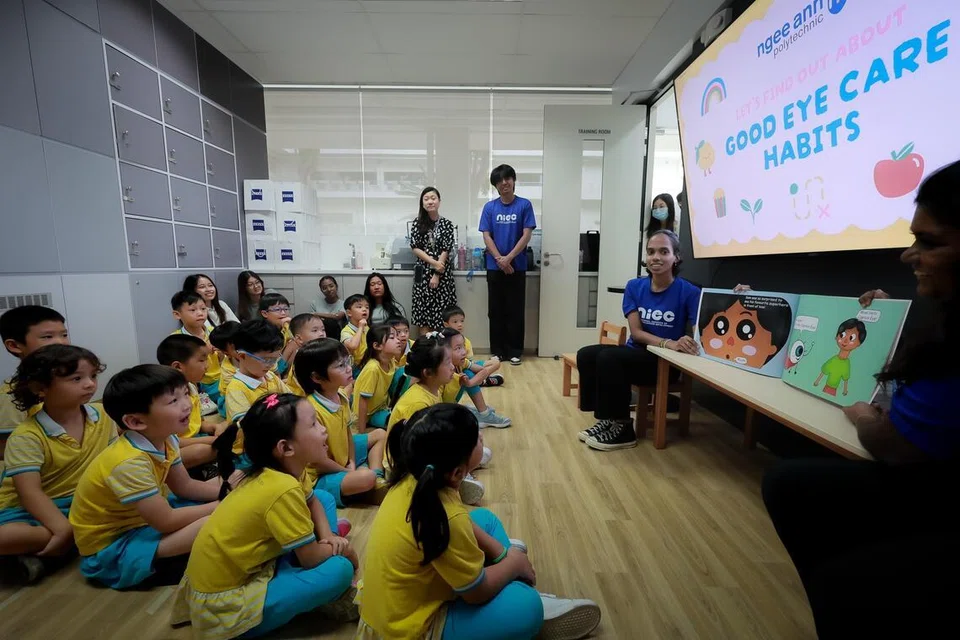
Experts emphasise that early detection and treatment of myopia during childhood may help reduce the likelihood of serious eye problems later in life. In Singapore, public health programmes have introduced regular eye screening for children in early school years, allowing healthcare providers to identify myopia at an earlier stage.
Recent advances in eye care have also introduced treatments designed to slow the progression of myopia. These include specially designed corrective lenses and atropine eye drops, which clinical research has shown can significantly reduce the rate at which myopia worsens in children.
However, specialists note that many families do not adopt these interventions, sometimes due to cost or limited awareness. As a result, some children continue to rely on conventional corrective lenses that improve vision but do not address the underlying progression of myopia.
In response to the growing public health concern, a group of eye care professionals in Singapore has established the Myopia Society of Singapore, bringing together optometrists, ophthalmologists, paediatricians and vision researchers. The organisation aims to promote awareness of childhood myopia, support scientific research and provide guidance on evidence-based approaches to vision care.
Public health specialists stress that myopia should not be regarded as a minor or purely cosmetic issue. Instead, it represents a long-term eye health condition that may increase the risk of complications later in life if left unmanaged. As awareness grows, healthcare professionals in Singapore hope that improved education, screening and early intervention will help reduce the burden of vision-related diseases in future generations.